
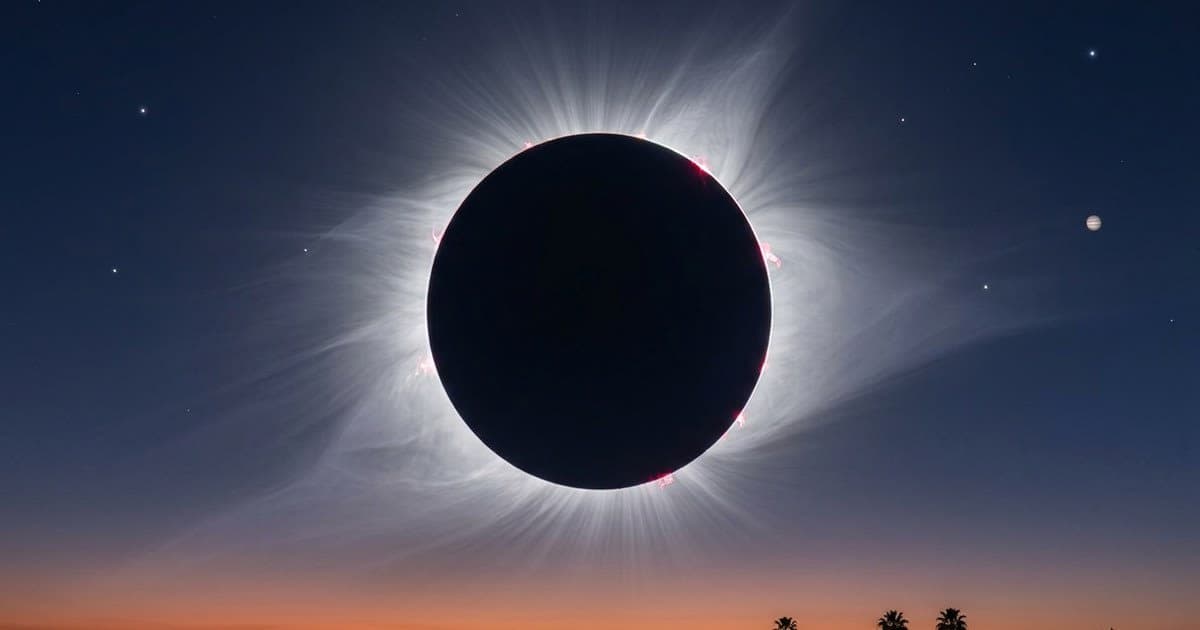
Eclipse 2027 · Guide
Where to see the 2027 total solar eclipse in Spain
By the Viajes Santa Mona team
On Monday 2 August 2027 the moon’s shadow crosses the Strait of Gibraltar and sweeps east along the North African coast. Southern Spain is the only place in continental Europe where the eclipse will be total, and it happens to be one of the driest, clearest places on the continent in early August. That combination is why people are already planning this trip.
This guide answers the question everyone actually has: where should I stand, and where should I sleep. All durations come from the Instituto Geográfico Nacional, Spain’s national mapping agency, calculated by subtracting its published start and end times of totality for each municipality. Where sources disagree, we say so rather than picking the number that suits us.
The one rule that explains the whole map
The moon’s shadow traces an oval across the earth. Inside that oval, totality lasts longest at the centre and drops to zero at the edge. For this eclipse the centre line passes over the Strait of Gibraltar. Everything else follows: the closer you are to the Strait, the more seconds you get.
What surprises people is that the fall-off is not gentle. Moving away from the centre costs you seconds at first, then whole minutes, and then throws you out of the path entirely. That is why the difference between a good decision and a ruined trip can be twenty kilometres.
How long totality lasts, town by town
| Place | Area | Totality |
|---|---|---|
| Ceuta | North Africa | 4 min 48 s (longest in Spain) |
| Tarifa | Cádiz | 4 min 38 s (longest on the mainland) |
| Melilla | North Africa | 4 min 34 s |
| Algeciras | Cádiz | 4 min 26 s |
| La Línea de la Concepción | Cádiz | 4 min 23 s |
| Barbate (incl. Zahara de los Atunes, Los Caños de Meca) | Cádiz | 4 min 15 s |
| Vejer de la Frontera (incl. El Palmar) | Cádiz | 4 min 05 s |
| Conil de la Frontera | Cádiz | 4 min 00 s |
| Manilva | Málaga | 3 min 47 s |
| Estepona | Málaga | 3 min 36 s |
| Chiclana de la Frontera (La Barrosa, Sancti Petri) | Cádiz | 3 min 28 s |
| Marbella | Málaga | 3 min 16 s |
| Fuengirola | Málaga | 3 min 10 s |
| Cádiz city | Cádiz | 2 min 54 s |
| Benalmádena | Málaga | 2 min 51 s |
| Torremolinos | Málaga | 2 min 40 s |
| Rota | Cádiz | 2 min 10 s (last point on the Cádiz coast with totality) |
| Málaga city | Málaga | 1 min 49 s |
| Almuñécar | Granada | 1 min 48 s |
| Nerja | Málaga | 1 min 39 s |
| Roquetas de Mar | Almería | 1 min 30 s |
| Jerez de la Frontera | Cádiz | 1 min 21 s |
| Ronda | Málaga | 1 min 18 s |
| Arcos de la Frontera | Cádiz | 36 s |
Durations calculated by subtracting the start and end times of totality published by the Instituto Geográfico Nacional for each municipality, except Ceuta and Melilla, where we use the figure the agency publishes directly. For anywhere not listed here, the reference is the agency’s own eclipse pages. Do not trust a figure that does not come from there.
The places that miss out, including some famous ones
This is the uncomfortable part and the most useful. Outside the path the eclipse will be partial everywhere in Spain, with a minimum obscuration of 70 per cent. It sounds like almost the same thing. It is not: no corona, no darkness, no stars.
- Seville, Huelva, Córdoba and Granada city are all outside, as is the entire Huelva coastline from Ayamonte to Matalascañas. Seville is the one that catches people out most often, because it is the obvious base for the region.
- Antequera and its whole district, despite sitting in the province of Málaga. The edge of the path crosses the province diagonally and does not follow administrative boundaries.
- Sanlúcar de Barrameda and Chipiona are both right on the northern edge, by margins smaller than any public model can guarantee, and the Instituto Geográfico Nacional publishes no totality times for either. Treat both as unconfirmed. Rota, fifteen kilometres south, is comfortably inside.
- Almería city is disputed. The agency’s tables place it outside; some tourism listings circulated in the Spanish press include it. We cannot resolve that from here, so we treat it as doubtful and would not book there for the eclipse.
Village names are not municipalities
Several of the most sought-after beaches do not appear in official tables under their own name, because they are hamlets rather than municipalities. Zahara de los Atunes, Atlanterra and Los Caños de Meca belong to Barbate; Bolonia and Valdevaqueros to Tarifa; El Palmar to Vejer; La Barrosa and Sancti Petri to Chiclana; Roche to Conil. Always look up the municipality, never the name in the listing.
What the morning actually looks like
The partial phase starts at around 09:40. Totality arrives between roughly 10:45 and 10:49 depending on how far east you are, and the whole event finishes close to 12:00. So you are committing to about two and a half hours outdoors, in southern Spain, in August, at an hour when it is already hot. Shade, water and a toilet nearby are not luxuries that day.
You do not need high ground. At 10:45 the sun sits some 38 to 40 degrees above the horizon towards the east-southeast, so all you need is nothing directly in front of you in that direction. The horizon that does matter is the western one: the shadow arrives from the Atlantic, so from the Costa de la Luz you can watch the front of darkness race towards you across the sea. It is the most extraordinary moment of the whole phenomenon, and that coast is oriented for it.
The five things that decide where you should be
- Being inside the path. Binary, and it beats every other consideration. An uncomfortable spot inside totality is worth infinitely more than the finest viewpoint outside it.
- Being able to get there and park. This is where most mornings will be won or lost. Parking near a famous Cádiz beach on an August Monday is already hard without an eclipse.
- Capacity. A five-kilometre beach that holds tens of thousands is a different proposition from a beautiful cove that holds two hundred. That day, the number of hopefuls will be far above normal.
- An open western horizon, for the reason explained above. An Atlantic advantage the Mediterranean coast does not have.
- Shade, water and facilities. Two and a half hours in the August sun is what separates enjoying the morning from enduring it.
And a sixth that is really a summary of the rest: the best spot is the one you can walk to from your bed. That makes choosing accommodation the same decision as choosing your viewing point, which is why we treat them together. Thirty seconds of extra totality do not justify driving that morning.
Three realistic plans
If you want maximum minutes and will get up early: the Tarifa and Barbate stretch, or Ceuta if the ferry works for you. If you want the best balance of duration, space and calm: El Palmar, Conil or the town beach at Barbate, all around four minutes. If you are travelling with children or want hotel infrastructure: Chiclana on the Atlantic side or Estepona and Manilva on the Costa del Sol, where you give up half a minute and gain thousands of hotel rooms, pools and parking. All three are covered in detail in the articles below.
Frequently asked questions
When exactly is the 2027 total solar eclipse in Spain?
Monday 2 August 2027. The partial phase begins at around 09:40 local time, totality arrives between roughly 10:45 and 10:49 depending on where you stand, and the whole event is over close to 12:00. That is peninsular Spanish time. The date matters as much as the place: 31 July is a Saturday and 1 August a Sunday, so a single day off turns it into a long weekend, and that is one reason demand for those two nights will be unusual.
Where does totality last longest?
In Ceuta, the Spanish city on the North African coast, with 4 minutes and 48 seconds according to the Instituto Geografico Nacional, Spain's national mapping agency. That is the maximum anywhere in Spanish territory. On the mainland the longest is Tarifa, at around 4 minutes and 38 seconds, followed by Melilla with 4 minutes and 34 seconds, Algeciras with 4 minutes and 26 seconds and La Linea with 4 minutes and 23 seconds. The reason is purely geometric: the centre line of the shadow passes over the Strait of Gibraltar, and duration depends only on how close you are to that line.
How much does duration drop as you move away from the Strait?
Faster than most people expect, and not smoothly. Tarifa has 4 minutes 38 seconds; Conil, about seventy kilometres up the coast, has 4 minutes exactly; Cadiz city, forty kilometres further, drops to 2 minutes 54 seconds; Jerez, thirty kilometres inland, to 1 minute 21 seconds; and twenty kilometres beyond that, at Sanlucar de Barrameda, totality disappears altogether. It is a ramp that ends in a cliff, which is why the northern edge of the province of Cadiz is where a booking mistake costs the most.
Which well-known places are outside the path of totality?
Seville, Huelva, Cordoba and Granada city are all outside, along with the entire Huelva coastline from Ayamonte to Matalascanas. So is Antequera and its whole district, despite being in the province of Malaga. Sanlucar de Barrameda and Chipiona both sit right on the edge, by margins smaller than any public model can guarantee, and the Instituto Geografico Nacional publishes no totality times for either. Almeria city is disputed between sources; we treat it as doubtful. Outside the path the eclipse is partial, at least 70 per cent across Spain, which sounds similar and is a completely different experience.
Do I need a clear horizon or high ground?
Not to see the sun. At around 10:45 the sun sits some 38 to 40 degrees above the horizon towards the east-southeast, so you only need nothing directly in front of you in that direction. No hill required. There is a separate reason to want an open horizon, and it points west: the moon's shadow arrives from the Atlantic and races east, so from the Costa de la Luz you can watch the wall of darkness approach over the sea a few seconds before it reaches you. That is a genuine advantage of the Atlantic coast that the Mediterranean side does not have.
Is a 99 per cent partial eclipse nearly as good?
No, and this is the single most important thing to understand before booking. Totality is not a deeper version of a partial eclipse, it is a different phenomenon. Without totality there is no solar corona, the sky does not go dark, the stars do not come out and the temperature does not drop. Even the 36 seconds available at Arcos de la Frontera is a categorically different experience from a 99 per cent partial an hour up the road. Check your exact municipality before you book anything, never the province.
How far in advance should I book?
As far ahead as you can, and preferably on flexible terms. The date cannot move, the strip of land cannot move, and the number of beds inside that strip is fixed. In previous total eclipses elsewhere, accommodation inside the path sold out many months ahead, and in areas with little hotel capacity it went more than a year ahead. We expect Spanish coastal hotels to publish August 2027 rates around late 2026. We are not going to invent a price for you at this distance.
Join the priority list
We’ll message you on WhatsApp when eclipse hotels in the totality zone open bookings (expected November 2026). Hotel-only bookings welcome — arrange your own flight.
Chat with us on WhatsAppKeep reading