
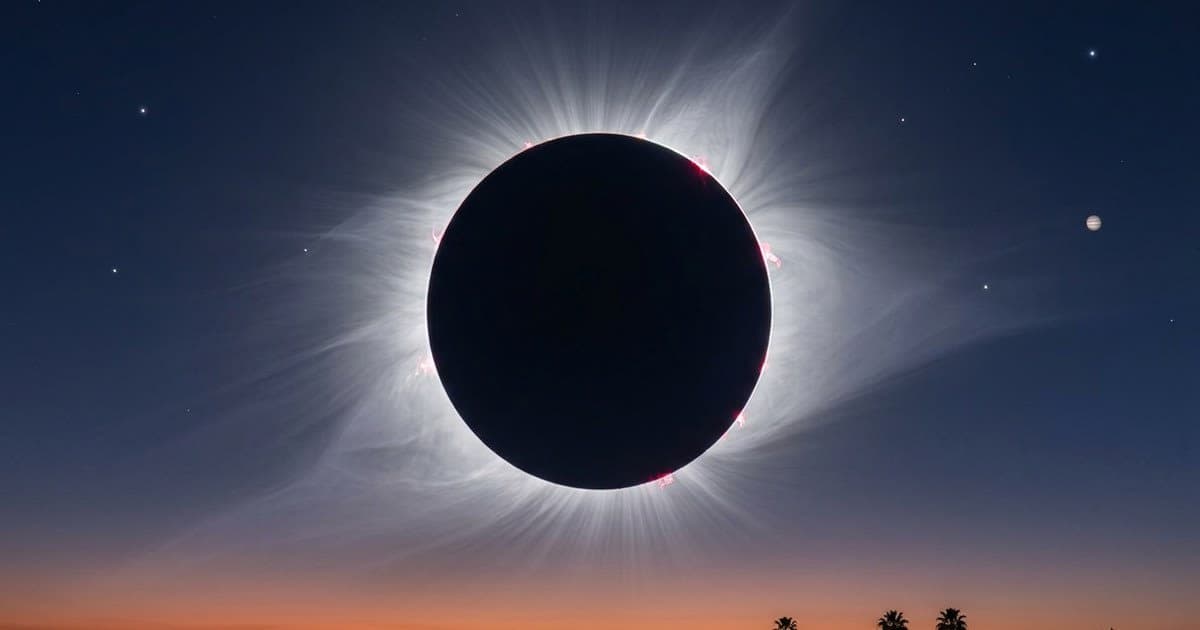
Eclipse 2027 · Destinations
Ceuta: the longest totality of the 2027 eclipse, and the ferry problem
By the Viajes Santa Mona team
There is one fact about the eclipse of Monday 2 August 2027 that hardly anyone has in mind and that reorders everything else: the point in Spain where totality lasts longest is not on the mainland. It is Ceuta, the Spanish city on the North African coast, with 4 minutes and 48 seconds — 288 seconds — according to the figure published by the Instituto Geográfico Nacional. The second longest is not on the mainland either: Melilla, with 4 minutes and 34 seconds, also an official figure.
That said, this article is not going to try to talk you into crossing the Strait. It gives you the real numbers, where to stand in each city, and above all why the problem with this plan is not astronomical but logistical: ferry seats and hotel beds are a fixed, small number, and there is no way to manufacture more of them for one day.
The numbers, unadorned
These two figures are among the very few in this whole eclipse that we can give to the second without faking precision, because they are published by the Spanish national mapping agency rather than calculated by us:
- Ceuta: 4 minutes 48 seconds. Totality begins around 10:45 and maximum eclipse falls at about 10:48, peninsular Spanish time. It is the maximum for all Spanish territory.
- Melilla: 4 minutes 34 seconds. Totality begins around 10:48 and maximum around 10:50. Melilla lies some three hundred kilometres further east, so the shadow arrives a few minutes later.
For context, the best of the mainland: Tarifa has around 4 minutes 38 seconds and Algeciras around 4 minutes 26 seconds. In other words, the difference between Ceuta and the best point on the mainland is about ten seconds.
The uncomfortable conclusion of that paragraph
Crossing the Strait cannot be justified by the seconds. Ten seconds on top of almost five minutes is imperceptible. It can be justified by other things — a whole city with room to spread out, a journey that is part of the trip, not depending on a gridlocked coast road — and anyone selling it to you as «the best place in Spain» without explaining the rest is telling you half the story.
Ceuta: where to stand
Ceuta has a geographical advantage no other Spanish city on this list has: it is an isthmus between two seas, with Monte Hacho on one side and the Strait in front. You can choose your orientation on foot.
The southern face, the one looking onto the Strait, is the one you want if you mean to watch the shadow arrive. The moon casts its shadow from the Atlantic and it travels east, so from the Ribera promenade, the Chorrillo area and the Parque Marítimo you can look west and see the front of darkness racing towards you over the water. It is the most extraordinary moment of the whole phenomenon and here you get it as standard.
Monte Hacho and the high viewpoints are the photography option. From up there you see the entire landscape darken, with the Spanish mainland opposite and Africa behind. It is spectacular, and it has the usual viewpoint problem: very few cars fit, and they will fill before dawn. The same applies to the Murallas Reales, which are beautiful and not large.
Our practical recommendation is the least dramatic one: the seafront promenade, walking from your hotel. At 10:45 the sun is some forty degrees above the horizon, so you need no elevation at all, only nothing directly in front of you towards the east-southeast. Everything else — shade while you wait, water, a toilet nearby, not depending on a car — the city gives you and a hillside does not.
Melilla: where to stand, and one difference worth knowing
Melilla has its 4 minutes 34 seconds and a different geography: here the sea is to the east, and the west is land. That has a specific consequence almost no article explains: from Melilla you will not see the shadow arrive over water, because it comes in over the interior. You will see it arrive across the landscape, which is also striking, but it is not the same.
In exchange, Melilla has a long and very comfortable seafront. The urban beaches north of the city — Los Cárabos, La Hípica, San Lorenzo — are continuous stretches of sand with a promenade, walkable from almost anywhere in the centre, with room to spare. Melilla la Vieja, the walled quarter on the promontory, is the viewpoint option: height, views over the port and bay, and the least capacity of all.
One timing detail that matters more than it sounds: in Melilla totality starts about three minutes later than in Ceuta. It does not change the plan, but if you are meeting someone, setting up a tripod or explaining it to a child, that offset is real.
Getting there: the ferry is the bottleneck, and that is not an exaggeration
This is the important section. Everything else can be improvised; this cannot.
Ceuta is reached by boat from Algeciras, with fast crossings of around an hour and several sailings a day, and by helicopter from Málaga, which is a token number of seats. There is no airport. Everyone who wants to be in Ceuta on 2 August has to fit onto the boats running that weekend, and that number does not grow because there is an eclipse.
Melilla is reached by air and by sea. There is an airport, with connections from several Spanish cities, but it is small, operated with turboprop aircraft and notoriously sensitive to wind and visibility: cancellations and diversions are part of the landscape. By sea there are ferries from Málaga, Motril and Almería, long crossings of several hours, with overnight departures.
From all of which come three rules we will not stop repeating:
- Book the boat before the hotel. That is the reverse of what everyone does, and here it is correct: you can change hotel, you cannot multiply ferry capacity. If you are taking a car, vehicle space is scarcer still than passenger space.
- Arrive the day before, or two days before. Crossing on the morning of the eclipse means betting the whole trip on there being no delay. The event happens at 10:45 and is not postponed.
- Leave the return loose. On 2 and 3 August the boats back will be as full as the boats out. Do not chain a flight from the mainland to a crossing a few hours earlier.
And an honest weather warning: the levante is the house wind of the Strait in summer, and when it blows hard it disrupts crossing schedules. This is not rare bad luck, it is normal several times each August. Any plan that depends on one specific boat at one specific hour that morning is a bad plan.
The beds: the second problem, pointing the same way
Ceuta and Melilla have hotel stock built for business travel and short visits, not thousands of apartment beds like Chiclana or Fuengirola. The number of beds is small and fixed. The consequence is different from what people expect: in a big destination, booking late means paying more. Here, booking late means there is nothing, and the plan then becomes crossing and returning on the same day, which is exactly the plan we have just advised against.
How we would do it, in three sentences
If you already have a bed on the Cádiz coast, stay put: ten seconds are not worth a Strait. If you have nothing booked and fancy the journey, Ceuta is an excellent option provided you build it backwards — boat first, then hotel, arriving the day before. And if you go to Melilla, allow a full day of slack either side, because the airport and the ferry are more in charge than you are.
Frequently asked questions
How long does totality last in Ceuta?
4 minutes and 48 seconds — 288 seconds — with totality beginning around 10:45 peninsular Spanish time and maximum eclipse at about 10:48. That is a figure published directly by the Instituto Geografico Nacional, Spain's national mapping agency, which is why we can give it to the second. It is the longest totality anywhere in Spanish territory, ahead of Tarifa and of any point on the mainland.
And Melilla?
4 minutes and 34 seconds, also a published figure from the Instituto Geografico Nacional, with totality beginning around 10:48 and maximum around 10:50. Fourteen seconds less than Ceuta, and still longer than anywhere on the Spanish mainland. Melilla sits some three hundred kilometres further east, which is why the shadow reaches it a few minutes later.
Is it worth crossing the Strait for ten seconds more than Tarifa?
For the seconds alone, no. Tarifa has around 4 minutes 38 seconds, so the gap to Ceuta is about ten seconds and nobody can perceive that. Crossing makes sense for other reasons: Ceuta is a city with promenades, services and space, whereas Tarifa will be overwhelmed that day; arriving by boat does not depend on the coastal road traffic; and for many people the crossing itself is part of the trip. If you already have a bed on the Cadiz coast and you are chasing minutes, stay where you are.
What is the real problem with going to Ceuta that day?
The ferry seat. Ceuta connects to mainland Spain by ferry from Algeciras, with crossings of around an hour, and by helicopter from Malaga. There is no airport. That means all the demand of an exceptional day is funnelled into a fixed number of seats which is already busy in August, and the number does not grow because there is an eclipse. The eclipse does not wait: if your morning boat is delayed or cancelled, there is no plan B. Sleep in Ceuta the night before and book the crossing very far in advance.
Can I do it as a day trip from Algeciras?
You can propose it and we do not recommend it. On paper the crossing is short and leaves plenty of margin. In practice, that Monday the port of Algeciras will see demand far above normal, boarding happens well ahead of departure, the entry checks are another step, and the margin to be in place before 10:45 narrows with any incident at all. A strong levante wind can disrupt crossing times. If the eight o'clock boat does not sail, you watch the eclipse from the port queue.
How do you get to Melilla?
By air and by sea. Melilla does have an airport, with flights from several Spanish cities, but it is a small airport operated with turboprop aircraft and it is notably sensitive to wind and visibility — cancellations and diversions are not unusual. By sea there are ferries from Malaga, Motril and Almeria, with long crossings of several hours and overnight departures. Either way the conclusion is the same as for Ceuta: be there the day before.
Is there enough accommodation in Ceuta and Melilla?
Not for what may come. Both are cities whose hotel stock is built for business travel and transit, not for a tourism peak. The number of beds is small and cannot be expanded. That is the second bottleneck after the boat, and it works in the same direction: whoever books late will not find a high price, they will find nothing at all.
Where should I stand in Ceuta?
The southern face of the city, the one looking onto the Strait, is the good side if you want to see the shadow arrive. The moon's shadow comes from the Atlantic and travels east, so from the Ribera promenade, the Chorrillo area and the Parque Maritimo you can look west and watch the front of darkness approach over the water seconds before it reaches you. Monte Hacho and the high viewpoints are the photography option, spectacular and with very little parking. Our practical recommendation is the least dramatic one: the seafront promenade, on foot from your hotel.
Join the priority list
We’ll message you on WhatsApp when eclipse hotels in the totality zone open bookings (expected November 2026). Hotel-only bookings welcome — arrange your own flight.
Chat with us on WhatsAppKeep reading