
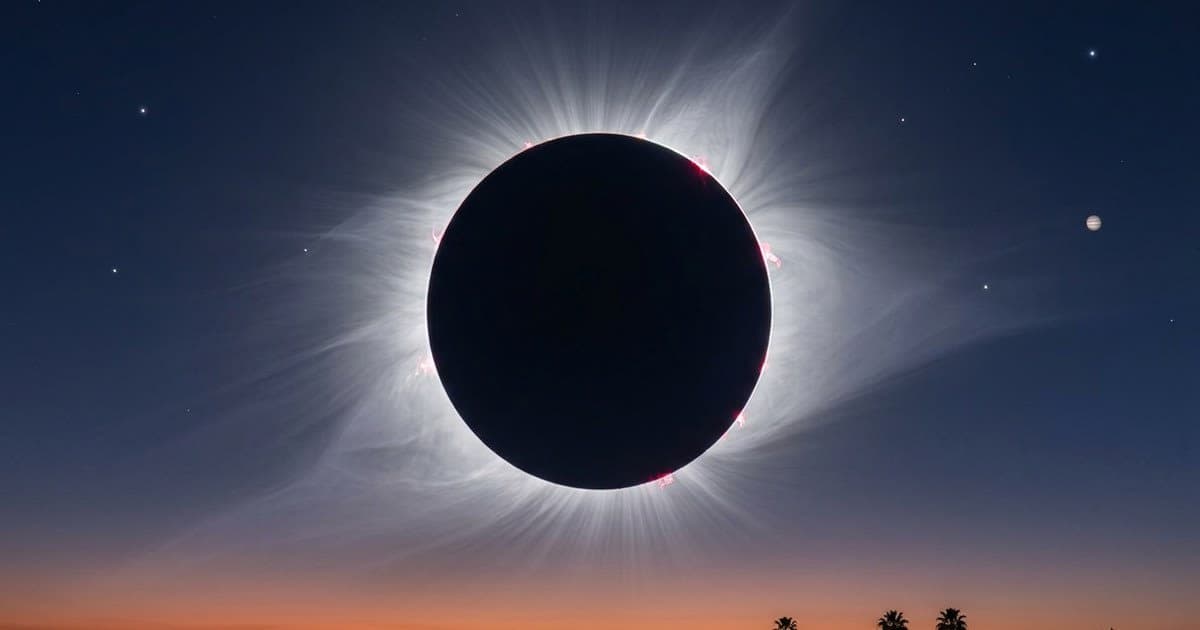
Eclipse 2027 · Weather
2027 eclipse weather in Spain: cloud risk, coast by coast
By the Viajes Santa Mona team
You can book the best four minutes on the Spanish mainland and still see nothing. That is the sentence the affiliate pages leave out, and it is the reason experienced eclipse chasers look at cloud statistics before they look at durations.
The headline for 2 August 2027 is genuinely good: southern Spain in early August is one of the most reliable places and dates you could ask for. But the risk is not spread evenly across the band, and the differences run in the opposite direction to the durations. Here is what the climatology actually says, from a licensed Spanish travel agency that watches this coast wake up every morning of the year.
Why this eclipse is a good bet
Two things work in your favour. The first is the season and the latitude: the far south of Spain in the first week of August sits under a settled summer regime, and the Instituto Geográfico Nacional describes the regions where this eclipse is visible as areas of low probability of cloud cover, with the single qualification that it is slightly higher in western Cádiz because of humid air coming in off the Atlantic.
The second is the time of day. The partial phase starts around 09:40 and totality arrives around 10:45, with the sun some 38 to 40 degrees above the horizon to the east-south-east. That matters more than it sounds. A high sun means less atmosphere in the line of sight, and a mid-morning eclipse gives the sun an hour or two of working time to burn back any overnight low cloud before the moment that counts. Compare that with 2026, whose totality came in the evening with the sun low.
The real risk: Atlantic morning stratus
The specific hazard on this coast is not a thunderstorm or a front. It is marine stratus: a shallow sheet of low cloud and fog formed over the cool water of the Canary Current, which drifts onto the Atlantic shore overnight and usually burns back during the morning.
Eclipsophile, the standard reference for eclipse climatology, records Cádiz at around 88 per cent frequency of sun-visible occasions in its August records, against about 74 per cent for Barbate, Atlanterra and Tarifa further down the coast. It also makes the observation that matters most for choosing a base: ocean cloudiness usually does not push east past Tarifa into the Strait, which is why the Alborán coast around Marbella does comparatively well.
The awkward trade-off
The stretch with the longest totality on the mainland — Tarifa, Barbate, Zahara, Los Caños — is also the stretch with the highest morning cloud risk in the record. The stretch with the best cloud odds, the eastern Costa del Sol, has the fewest minutes. There is no location that wins both, and anyone who tells you otherwise is selling something. Our reading is that around three and a half minutes in Estepona or Manilva is the best balanced point on the whole band.
The levanter, and the Rock’s banner cloud
The Strait has its own weather, driven by two named winds that everyone here talks about. The levante — the levanter — is the easterly that funnels through the gap; Eclipsophile describes it as throwing a streaming banner of cloud off the upper slopes of the Rock and producing a stable, surface-based inversion, giving the area a misty character that is usually semi-transparent once the sun has worked on it for an hour or two. The poniente, the westerly, brings good summer visibility. The satellite record makes the waters of the Alborán Sea and the Strait cloudier than any other part of the western track, and Eclipsophile gives the Gibraltar area around a 74 per cent chance of a sunny view while adding that this is too pessimistic for an observer who can move. The levante also matters for a second, less discussed reason: it can blow hard enough on the Cádiz coast in August to make sitting on a beach for two and a half hours genuinely unpleasant and to ruin any tripod work.
What August 2026 taught, eight days ago
Spain does not have to speculate about this any more. At the total eclipse of 12 August 2026, millions watched under clear skies while cloud spoiled the view along parts of the Cantabrian coast. The people who had chosen an inland site did better than the people who had committed to a shoreline. The southern climatology for 2027 is significantly kinder than the northern climatology was for 2026, but the transferable lesson is not about the sky. It is that the observers with options did better than the observers without them.
How to book for a cloud risk you cannot forecast
Nobody can forecast 2 August 2027 from here. Climatology tells you the odds; it does not tell you the day. What you can do is book so that the odds are on your side and a bad morning is survivable:
- Prefer a base with more than one viewpoint within twenty minutes. A town with a beach, a headland and a bit of high ground behind it is worth more than a slightly longer totality at a dead end.
- Consider the first ridge inland. Vejer on its hill, Medina Sidonia, Benalup or Casares all keep well over three minutes and sit behind the coastal cloud fringe.
- Do not plan a long chase. Roads inside the band will be saturated and totality does not wait. Twenty minutes of repositioning is a plan; a hundred kilometres is a gamble.
- Check the forecast at seven in the morning, not the night before. Marine stratus is a short-range phenomenon and Spain’s national meteorological agency publishes satellite imagery that will tell you what is sitting on the coast.
- Accept the residual risk. Every eclipse carries it. This one carries less than most.
Frequently asked questions
What are the chances of clear skies for the 2027 eclipse in Spain?
Good, and better than almost any other total eclipse this century. Spain's Instituto Geografico Nacional describes the regions where the eclipse is visible as areas with a low probability of cloud cover, noting only that it is slightly higher in western Cadiz because of humid air coming in off the Atlantic. The eclipse also happens around 11 in the morning with the sun high, which helps in two ways: there is less atmosphere in the line of sight, and the sun has had an hour or two to burn off any overnight low cloud before totality arrives.
Which part of the band has the best weather odds?
Broadly, the further east and the further from the open Atlantic, the lower the morning cloud risk. Eclipsophile, the reference source for eclipse climatology, records Cadiz at around an 88 per cent frequency of sun-visible occasions in its August records, against about 74 per cent for the sites further down the Atlantic coast at Barbate, Atlanterra and Tarifa. It also notes that ocean cloudiness usually does not push east past Tarifa into the Strait, which is why the Alboran coast around Marbella does comparatively well. The trade-off is obvious and unavoidable: the same stretch that has the best cloud odds has fewer minutes of totality.
What is the levanter and does it matter?
The levanter is the easterly wind that funnels through the Strait of Gibraltar, and it is the local variable that most affects what you will see. Eclipsophile describes it as producing a streaming banner of cloud off the upper slopes of the Rock together with a stable, surface-based temperature inversion, while the poniente, the westerly, brings good visibility in the summer months. In practical terms the Strait and the Alboran Sea are cloudier in the satellite record than any other part of the western track, and the Gibraltar area is given around a 74 per cent chance of a sunny view — a figure Eclipsophile itself calls too pessimistic for an observer who is able to move.
Should I stay inland instead of on the coast?
It is a legitimate hedge, and Eclipsophile's own advice for Atlantic morning cloud is to go inland, since ocean cloud is blocked by the rugged terrain. Inside the band that means places like Benalup-Casas Viejas at 3 minutes 49 seconds, Casares at 3 minutes 31 seconds, Medina Sidonia at 3 minutes 20 seconds or Vejer, which sits on a hill above the coastal fringe. The counter-argument is that the coast is where the beds and the beaches are, and that watching the shadow arrive across the ocean is one of the great experiences this particular eclipse offers. Our own view is that the coast is worth the small extra risk, provided you are not immobile.
What happened with the weather at the 2026 eclipse in Spain?
Exactly the split you would expect, and it is the reason to take this seriously rather than assume Spanish summer equals guaranteed sun. On 12 August 2026 millions of people saw the eclipse under clear skies, while cloud spoiled the view along parts of the Cantabrian coast. The people who had chosen inland sites did better than the people on the shoreline. The 2027 climatology in the south is considerably more favourable, but the lesson about mobility transfers directly.
Can I do anything about it on the day?
A little, and less than eclipse forums suggest. Spain's national meteorological agency publishes detailed short-range forecasts and satellite imagery, and the morning of the eclipse you will have a fair idea by around seven o'clock whether the coast is under stratus. What you should not plan is a long chase. That morning the roads inside the band will be carrying enormous traffic and totality arrives around 10:45 with no second chance. A twenty-minute reposition to a site you already know is sensible. A hundred-kilometre dash on the day is how people miss it.
We live here, and we know which bases give you options
We’ll message you on WhatsApp when eclipse hotels in the totality zone open bookings (expected November 2026). Hotel-only bookings welcome — arrange your own flight.
Chat with us on WhatsAppKeep reading